
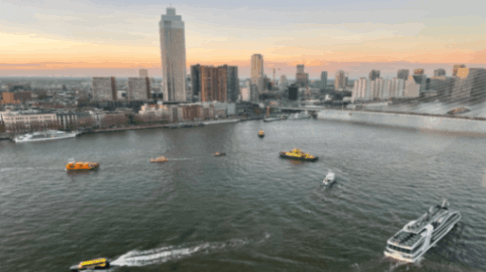
New Speed Limits Take Effect on Rotterdam’s Nieuwe Maas to Boost Shipping Safety
Shipping traffic in the Erasmusbrug area of Rotterdam will be subject to new speed limits starting 1 April 2026, aiming to improve safety on one of the busiest stretches of Dutch waterways.
Within the designated Erasmusbrug zone—from the Waterbus jetty at Willemskade to the radar tower at Boompjes—vessels will be limited to a maximum speed of 20 kilometres per hour. The approach areas to the zone, between Sint Jobshaven and Nassauhaven, will have a 50 kilometres per hour speed limit. Clear signage will indicate both zones along the waterway.
The measures apply to all vessels, including inland ships, water taxis, the Waterbus, sloops, and fast rigid hull inflatable boats (RHIBs). By reducing speed, skippers are expected to have more time to react in the complex traffic mix. Additional regulations require vessels to keep to the starboard side and prohibit turning within the zones.
‘With these sailing rules, we are bringing more calm and clarity to a busy sailing area,’ says René de Vries. ‘Lower speeds allow skippers to better assess the situation on the water. The Nieuwe Maas must be safe for everyone, from recreational to commercial shipping. By making sailing traffic more predictable, we can significantly reduce the risk of incidents.’
These safety rules respond to recommendations from the Dutch Safety Board and a nautical risk analysis, following collisions in recent years. The Ministry of Infrastructure and Water Management has updated legislation to enable enforcement, with Harbour Master René de Vries issuing a uniform traffic order.
Enforcement will be carried out by the Harbour Master and the Seaport Police, who will monitor speeds using laser equipment. The maximum speed limit will be adjusted relative to the Nieuwe Maas’s current flow velocity.
To further support compliance, the Port of Rotterdam Authority is installing zone markers and developing the Ship Traffic Monitor, a tracking tool that maps vessel speeds and patterns. This system will help ensure ships maintain proper lane discipline and adhere to speed limits, while facilitating dialogue between authorities and waterway users.

