
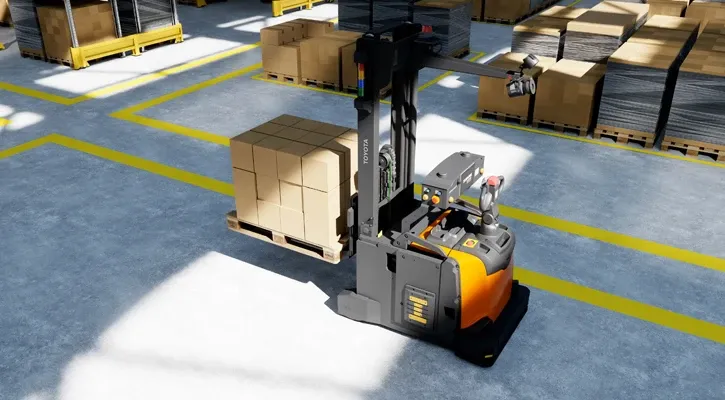
Toyota, NVIDIA and SoftServe Target 50% Reduction in Autonomous Forklift Commissioning Time
Toyota Material Handling Europe has announced a collaboration with NVIDIA and SoftServe aimed at reducing autonomous solution commissioning efforts by up to 50% through physical AI, simulation and digital twin technologies.
The initiative combines Toyota Material Handling’s engineering expertise and lean manufacturing principles with NVIDIA’s Omniverse libraries, the NVIDIA Isaac Sim robotics simulation framework and SoftServe’s digital engineering capabilities. The goal is to enable autonomous forklifts to be developed, tested and validated in virtual environments before being deployed at customer sites.
“Through virtual commissioning and digital twin technology, we can secure quality while eliminating muda, or waste, before deployment begins,” said Johan Rosén, Senior Vice President Research & Development at Toyota Material Handling Europe. “By identifying and resolving issues earlier in the process, we can reduce implementation effort, accelerate customer value, and deliver automation solutions with greater confidence.”
Under the simulation-first approach, Toyota Material Handling Europe can create digital replicas of customer facilities to assess autonomous vehicle performance, navigation, safety systems and operational behaviour under different conditions. This allows engineering teams to identify and address potential issues before installation, reducing the need for extensive on-site testing and adjustments.
SoftServe, an NVIDIA Elite Partner since 2022 and an NVIDIA Advanced Technology Partner since 2026, developed the digital twin environment underpinning the collaboration. The platform translates NVIDIA’s physical AI technologies into a production-ready simulation environment designed to minimise waste in time and resources during customer-site commissioning.
“Zero Muda sets a clear bar: eliminate waste before it happens, not after,” said Olha Moroz, EVP and Head of EMEA, SoftServe. “SoftServe is proud to support this by using NVIDIA Omniverse and simulation engineering built for Toyota Material Handling Europe’s customers — catching issues by using simulations in the digital twin world long before they could ever reach the forklift on the customer’s floor.”
By integrating NVIDIA Omniverse libraries and Isaac Sim into its engineering workflows, Toyota Material Handling can simulate factory layouts and validate autonomous forklift operations in complex warehouse environments. These simulations account for interactions with people, manually operated forklifts and other traffic on the shop floor, helping teams evaluate vehicle behaviour and safety logic before deployment.
Beyond autonomous vehicle development, the collaboration also explores the use of AI in production environments. Potential applications include quality inspection, predictive maintenance, process optimisation and energy management, supported by NVIDIA-powered vision AI and intelligent agents.
One application has already demonstrated improvements in object detection. To train a camera-based pallet detection module, the teams generated synthetic data using NVIDIA Omniverse libraries and augmented it with NVIDIA Cosmos open-world foundation models. According to the companies, this approach delivered an improvement of more than 70% in object-detection recall on the real-world warehouse datasets evaluated.
The initiative targets reductions of up to 40% in time-to-market and up to 50% in commissioning effort. By moving more testing and validation into simulation, the companies aim to reduce disruption at customer sites, improve solution quality before go-live and accelerate the transition from initial design to operational deployment.
The collaboration reflects a broader push to apply physical AI and digital twins to industrial operations, enabling manufacturers and logistics operators to improve engineering productivity, increase production flexibility and enhance product quality while controlling operational costs.
For Toyota Material Handling Europe, the approach is intended to support the wider deployment of autonomous material handling solutions by making implementation faster, more predictable and more resource-efficient.
“Our ambition is to achieve zero muda: removing waste that hinders productivity in material handling operations,” said Ernesto Dominguez, President and CEO of Toyota Material Handling Europe. “By combining our lean thinking and automation expertise with NVIDIA’s platform for Physical AI and SoftServe’s engineering capabilities, we can accelerate innovation, improve solution quality and help customers achieve zero muda in their automated and autonomous operations.”

