
Liebherr cranes support major bridge replacement project on Switzerland’s N16 motorway
Seven Liebherr cranes are supporting the construction of two new bridges on Switzerland’s N16 national road between Tavannes and Biel, helping contractors overcome challenging site conditions in one of the country’s most constrained infrastructure projects.
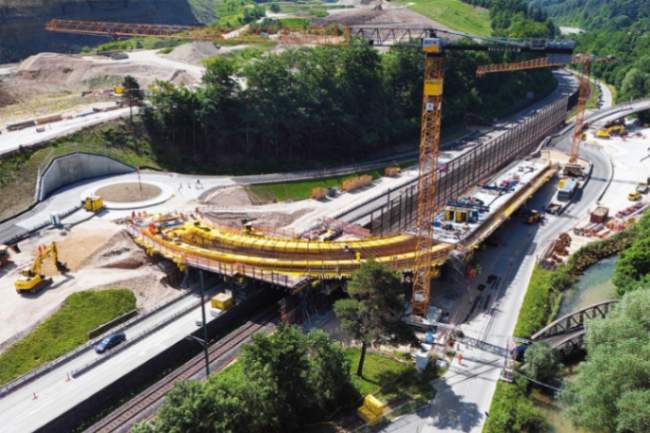
Commissioned by the Federal Roads Office (ASTRA), the bridge replacement works are being carried out by Walo Bertschinger AG in the canton of Bern. The project is located within a narrow valley where the motorway, railway line and river run in close proximity, while existing bridge structures further restrict available working space. Construction began in July 2024 and is scheduled for completion by December 2026.
The N16, also known as the Transjurane, provides a key connection between the canton of Jura and the Swiss Mittelland through the Bernese Jura region. Due to the limited access available at the site, only a restricted number of lorry deliveries can take place each day, making accurate planning and efficient material handling essential.
Liebherr cranes have been deployed throughout several construction phases. During work on the first D19 bridge between 2024 and 2025, a 270 EC-B 12 tower crane, a 90 EC-B 6 crane, a 65 K self-erecting crane and an L1-32 crane were used. For the second D19A bridge, construction from 2025 to 2026 will again rely on a 270 EC-B 12 and 90 EC-B 6, supported by an 81 K self-erecting crane.
The cranes are playing a central role in the construction process, including the installation of steel girders for temporary falsework structures, positioning of reinforcement materials, handling timber formwork systems and lifting auxiliary equipment. One of the project’s key challenges involved assembling a 22-metre falsework structure without intermediate support while maintaining precision in a restricted work area.
The proximity of the active railway line and motorway has required careful coordination with SBB Rail and strict safety procedures. Crane operations have been adapted to meet railway requirements, including the use of a telescopic crane within the track area. Some works are being completed during night-time and weekend closures to minimise disruption.
The project also includes specialist concrete works, bespoke formwork solutions and drilling operations carried out both within and outside the railway and road areas. Liebherr’s crane fleet is providing essential lifting capacity to support the delivery of this complex transport infrastructure upgrade.
“On a construction site bordered by a railway line and a motorway, every movement counts. With the Liebherr tower cranes, we can position the structural elements precisely and safely even under these cramped conditions and keep to our construction schedule as planned,” says Antonio D’Onofrio, Project Manager, ppa. at Ingenieurbau West, Walo Bertschinger AG.

